

PHAR 332 Directed Research Student Presentation Symposium
College of Pharmacy and Nutrition
By Jason PerepelkinAs part of the PHAR 332 Directed Research elective, on April 8th six PharmD students presented original research projects spanning pharmacy practice, clinical outcomes, analytical science, and health professions education. Each project addressed a real issue relevant to patient care, public health, or the future of pharmacy practice. Together, the session highlighted the depth and range of student‑led research taking place within the College of Pharmacy and Nutrition. Below is a high-level summary of each project.
 Project: Developing a Time‑and‑Motion Study Protocol for Community Pharmacists
Student: Chelsie Quach
Supervisor: Dr. Jason Perepelkin
Chelsie developed and piloted a time‑and‑motion study protocol to examine how community pharmacists spend their workday. The project focuses on identifying how much time is devoted to activities that require a pharmacist’s licence versus tasks that could be delegated within the pharmacy team.
Through a targeted literature review and hands‑on testing, Chelsie contributed to refining a real‑time observation tool/app and study procedures suitable for use in diverse community pharmacy settings. Her work included testing data collection methods, identifying feasibility challenges, and providing feedback to strengthen the study design.
This project supports ongoing research aimed at better understanding pharmacy workflow and identifying ways to expand pharmacists’ clinical capacity in response to increasing demands on primary care.
 Project: Evaluation of Glecaprevir/Pibrentasvir Use in Pediatric Patients with Hepatitis C
Student: Kavya Sudarasanam
Supervisor: Dr. Andrea Tang
Kavya conducted a retrospective case series describing real‑world use of glecaprevir/pibrentasvir (Maviret®) in children treated for chronic hepatitis C virus infection at Jim Pattison Children’s Hospital.
The study included 11 pediatric patients treated between 2022 and 2025. Kavya examined treatment efficacy, safety, adherence, and barriers to care using electronic medical record data. All patients with available follow‑up achieved sustained virologic response, and treatment was generally well tolerated, with no discontinuations due to adverse effects.
The project also identified important practical challenges, including swallowing difficulties, caregiver changes, access to medication, and rural–urban barriers. These findings highlight that while current antiviral therapies are highly effective, social and logistical factors strongly influence treatment success in pediatric populations.
 Project: Evaluation of an Interprofessional Educational Activity on Fetal Alcohol Spectrum Disorder
Student: Asees Basra
Supervisor: Dr. Holly Mansell
Asees evaluated an interprofessional education session on fetal alcohol spectrum disorder (FASD) designed for first‑year pharmacy and nutrition students. The two‑session activity combined didactic teaching, lived‑experience perspectives, and case‑based discussion.
Using a post‑session survey, Asees assessed changes in students’ self‑reported confidence related to FASD knowledge, stigma‑free communication, and interprofessional collaboration. Results showed clear improvements across confidence measures, with the elimination of low‑confidence responses following the sessions.
Students identified listening to lived experience, avoiding assumptions, and using patient‑centred communication strategies as key takeaways. The project demonstrates how structured, interprofessional learning can help prepare future health professionals to provide more supportive and informed care for individuals and families affected by FASD.
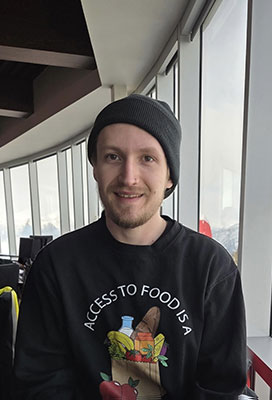 Project: A Systematic Review of Clozapine Use in Pediatric Populations
Student: Matt Kessler
Supervisors: Drs. Katelyn Halpape and Brooke Gessner
Matt conducted a systematic review examining the efficacy, safety, and monitoring practices associated with clozapine use in children and adolescents. While clozapine is approved for treatment‑resistant schizophrenia in adults, all pediatric use remains off label.
The review included 61 studies spanning observational trials, randomized controlled trials, and safety or pharmacokinetic studies. Across study types, clozapine was generally more effective than other antipsychotics for treatment‑resistant schizophrenia and showed benefit in reducing severe aggression, hospitalization, and restraint use in other psychiatric conditions.
Matt also highlighted the significant monitoring burden and the risk of rare but serious adverse effects, which remain major barriers to wider use. The review identified gaps in pediatric‑specific evidence, especially for non‑schizophrenia indications, and pointed to the need for better guidance around dosing and monitoring in pediatric practice.
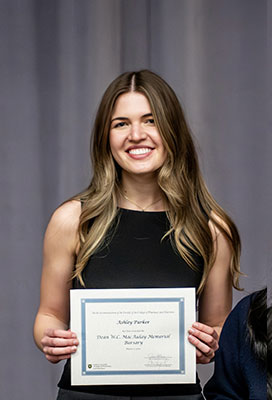 Project: Mass Spectrometric Analysis of Deoxynivalenol–Glutathione
Student: Ashley Parker
Supervisor: Drs. Anas El-Aneed & Radwa Asar
Ashley’s project focused on improving detection of deoxynivalenol–glutathione (DON‑GSH), a detoxified form of the mycotoxin deoxynivalenol (DON) that commonly contaminates grains. While DON‑GSH formation is an important resistance mechanism in plants, no validated analytical assay currently exists to detect it in food or crops.
Ashley prepared a laboratory standard and used tandem mass spectrometry (MS² and MS³) to characterize DON‑GSH fragmentation patterns. Her work produced a detailed fragmentation pathway (i.e., fingerprint) that can be used to confirm DON‑GSH identity in future analyses.
This project lays analytical groundwork for future development of analytical methods, using mass spectrometry that can be applied to food safety. The methods can be used in plant screening and to assess animal/human exposure in the future.
 Project: Interactions Between Ionizing Radiation and Melanin Pigment
Student: Carlos Zapien
Supervisor: Dr. Kate Dadachova
Carlos investigated how melanin interacts with high‑energy ionizing radiation and whether it maintains structural stability following radiation exposure. Melanin is known for its protective role against ultraviolet radiation, but its resistance to ionizing radiation is less well understood.
Using fungal‑derived melanin samples exposed to high‑dose proton radiation at the TRIUMF cyclotron facility, Carlos assessed molecular integrity using electron paramagnetic resonance (EPR) and Fourier‑transform infrared (FTIR) spectroscopy. The results showed preserved spectral features after irradiation, indicating that melanin maintains its structure under extreme radiation conditions.
These findings support the idea that melanin may have applications as a radioprotective material, with potential relevance to radiotherapy and protection of electronic systems used in space or high‑radiation environments.
Summary
Together, these projects reflect the breadth of research being undertaken by students in the PHAR 332 Directed Research elective. From community pharmacy workflow and pediatric drug therapy to analytical science and health professions education, each study addressed a practical question with clear relevance to pharmacy practice and patient care. The presentation symposium showcased not only strong technical work, but also the ability of students to engage critically with complex, real‑world issues.